Guinea Bissau at a Crossroads: Can Political Change Open the Door to a New Economic Future
Israel
News Feature with Samuel Shay, Entrepreneur and Senior Economic Advisor to the Abraham Accords Treaty, and CEO of Gulf Technologies Systems (GTS)
The recent coup in Guinea Bissau has drawn sharp condemnation across Africa and the international community. Yet beyond the political turmoil lies a deeper question now being raised by economic strategists and regional development experts: can this moment of instability become a turning point for the nation’s economic renewal?
In a special analysis, Samuel Shay explains that while no military takeover is desirable, transitions often create rare openings for structural economic reforms anchored in transparency, new partnerships and strategic leadership. Guinea Bissau, one of Africa’s most resource rich yet economically fragile countries, now stands at such a moment.
A Crisis That Reveals an Opportunity
According to Shay, the crisis in Guinea Bissau reflects not only political instability but decades of economic neglect. Agricultural systems remain underdeveloped, national infrastructure is weak, and water and energy networks suffer chronic failure. Despite vast natural potential in cashew production, fisheries, minerals and fertile land, most citizens continue to live in poverty.
“The question,” Shay says, “is whether the new authorities will repeat the cycle of instability or break it by adopting a serious economic vision.”
He argues that the collapse of democratic order often leads to short term deterioration, but it can also force a strategic reset that civilian leadership previously avoided. The key lies in using the transition to establish a practical, development driven agenda.
A New Economic Policy Pathway for Guinea Bissau
Shay outlines several areas where immediate policy action can transform the nation:
Agriculture:
Modernizing cashew production, introducing irrigation systems, and integrating Israeli precision agriculture can turn Guinea Bissau into a major West African agro exporter.
Energy:
Building small solar hydrogen hybrid stations, supported by Gulf investment, can solve chronic electricity shortages and power rural development.
Water Supply:
Deploying smart water management systems can eliminate shortages and support agriculture, health and sanitation.
Transport and Infrastructure:
Rehabilitating key roads, ports and logistics routes will allow farmers and businesses to reach markets in Senegal, Guinea, Cape Verde and the broader region.
“These steps are not theoretical,” Shay notes. “They are implementable within months if the government commits to transparency and serious partnerships.”
Engagement With President Trump and the Mineral Agreements
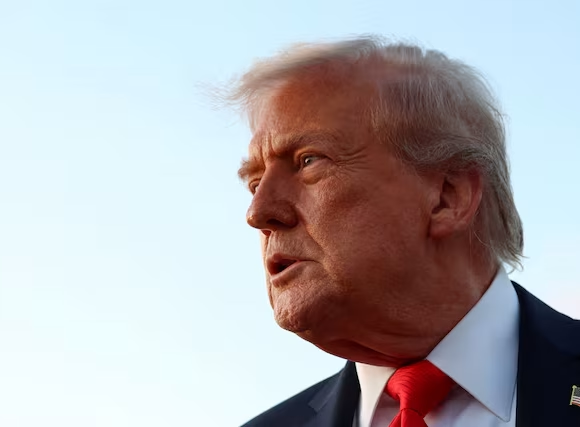
One of the most strategic decisions facing Guinea Bissau’s new leadership is whether to align itself with the economic architecture promoted by President Donald Trump under the emerging Mineral Agreements Initiative. This framework connects African nations with American investment, technology and industrial development strategies tied to transparency and economic modernization.
Shay believes Guinea Bissau can benefit immensely from joining this system.
“Guinea Bissau needs capital, management expertise and market access,” he says. “Trump’s mineral economic framework offers all three under clear rules of governance.”
By approaching Washington early, the new government could negotiate development programs that include:
• modernization of mineral extraction
• construction of agro processing zones
• development of renewable energy centers
• training and education partnerships
• water and transport infrastructure upgrades
This path would not only strengthen Guinea Bissau’s economy but also increase its legitimacy internationally.
A New Vision for National Renewal
Shay stresses that the real test will be whether Guinea Bissau’s leadership sees itself as temporary power holders or as architects of a long term national transformation.
“Political change is meaningless without economic direction,” he says. “If the new leadership stands before President Trump with a clear national vision, Guinea Bissau can enter a new era.”
He argues that aligning with the Abraham Accords economic network, Gulf financing and Israeli technology can give the country the tools it has lacked for decades: stable electricity, modern farming, clean water, and functioning infrastructure.
A Rare Moment for Strategic Courage
Ultimately, Shay believes the coup, while destabilizing, has opened a narrow window for decisive reform. If Guinea Bissau chooses a path of accountability, transparency and international partnership, the country can emerge stronger than before.
“If the new leadership turns outward, builds alliances and adopts a development first approach,” Shay concludes, “Guinea Bissau can move from crisis to opportunity and finally give its people the quality of life they deserve.”
The coming months will determine whether the nation’s political upheaval becomes another chapter of instability or the foundation of a new economic future for its citizens.